 Request Quote
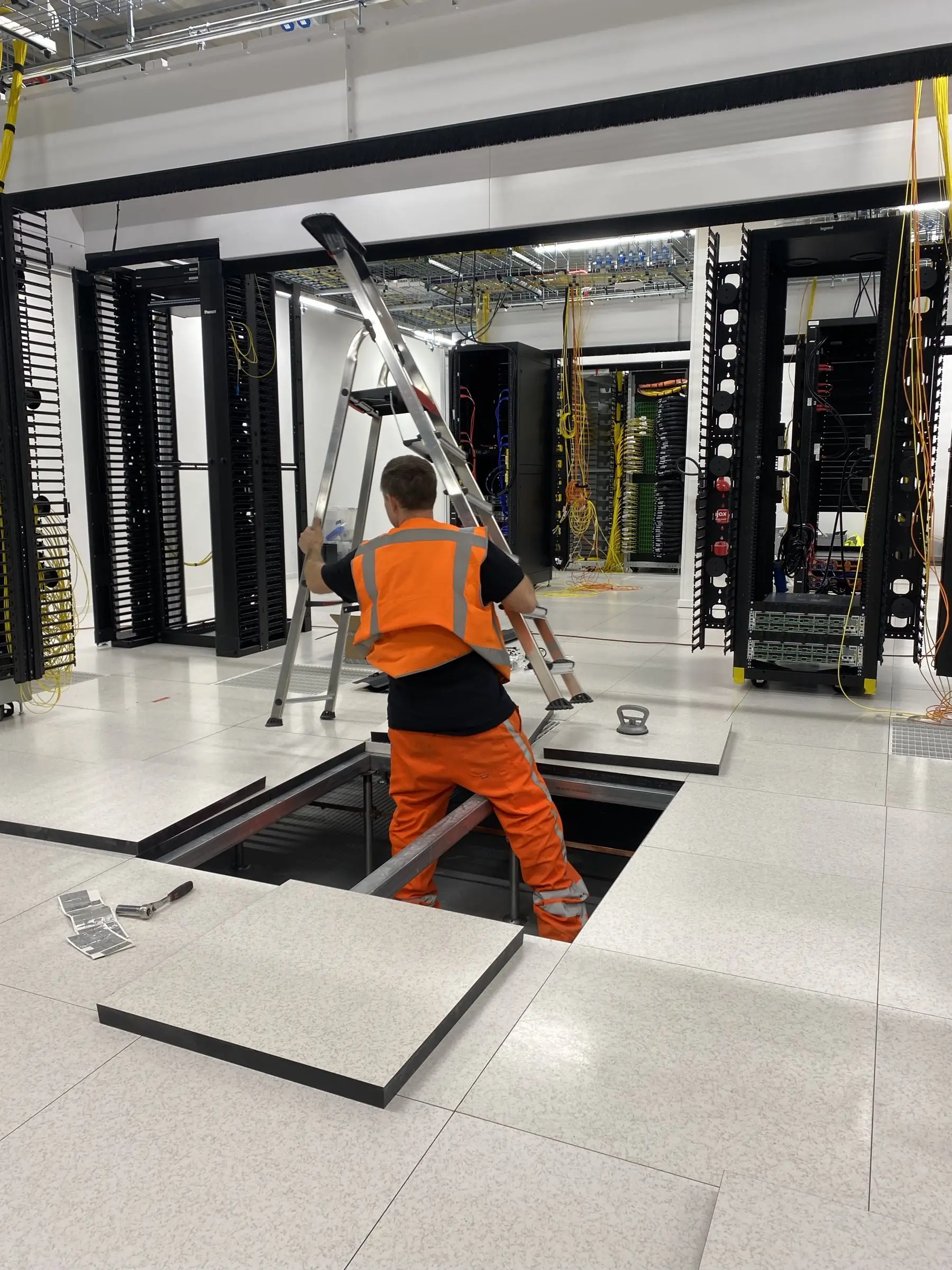
A raised access floor in a datacenter carries full server cabinets, UPS systems and cooling units. A computer floor carries a point load of up to 20 kN and a distributed load of up to 35 kN/m², a system floor up to 50 kN/m². Which floor you need depends on how the weight reaches the floor.
The load on a raised floor is expressed in two ways. It is important to keep them apart, because a floor can comfortably meet one value and fall short on the other.
In a datacenter the point load is usually decisive. A server cabinet stands on four feet or castors, and each of them presses on a small part of a single panel. Where several heavy cabinets stand side by side, the distributed load counts as well.
| Computer floor | System floor | |
|---|---|---|
| Point load | Up to 20 kN per point | Up to 20 kN per point |
| Distributed load | Up to 35 kN/m² | Up to 50 kN/m² |
| Construction | Panels on freestanding, adjustable pedestals | Panels on a steel frame of pedestals and stringers |
| Area in the datacenter | Data halls and server rooms | UPS rooms, battery rooms, heavy racks and cooling units |
The exact value depends on the panel type, the grid and the substructure. Read more about the difference between a computer floor and a system floor.
Not every panel carries the same load. The values below are taken from published product data of raised access floor manufacturers. The exact value depends on thickness, finish and substructure.
| Panel type | Point load | Use in a datacenter |
|---|---|---|
| Chipboard | Up to 10 kN | Lighter server rooms and office areas |
| Calcium sulphate | 2 to 20 kN | Data halls and plant rooms |
| Steel | 3 to 7 kN | Often used as a ventilation panel for cooling |
| Cast aluminium | 5 to 10 kN | Perforated panels with a high open area |
Take care with ventilation panels: because of the perforations they often carry less than a solid panel. Place heavy cabinets on solid panels or on a frame. You can read more about the materials in panel types compared.
The European standard EN 12825 divides raised floor panels into classes based on their ultimate load, from class 1 (at least 4 kN) to class 6 (at least 12 kN). The ultimate load is the load at which the panel fails. With the usual safety factor of 2, the permissible working load is half of that.
So always ask whether a stated value is the ultimate load or the working load. A panel with an ultimate load of 12 kN may be loaded with 6 kN in use.
For heavy equipment there are three solutions, which are often combined:
The raised floor passes the weight on to the subfloor, which must be able to carry the load as well. That is assessed by the structural engineer of the building.
If heavier equipment is installed in an existing hall, the floor does not always have to be replaced. We reinforce existing floors with stringers or frames and replace panels with a heavier version, including floors of other brands. We do this while the datacenter stays in operation. Read more about repair and modifications or view the projects AMS1 and EXA.
A computer floor carries a point load of up to 20 kN per point and a distributed load of up to 35 kN/m². The exact value depends on the panel type and the pedestal spacing.
The point load is the weight on one small area, such as the foot of a server cabinet, in kN. The distributed load is the weight spread over one square metre, in kN/m². In a datacenter the point load is usually decisive.
For heavy loads, such as UPS rooms, battery rooms, full racks or large cooling units. A system floor for datacenters carries a distributed load of up to 50 kN/m².
Yes. With steel stringers, frames under the cabinets or heavier panels, an existing floor can carry more. We carry out this work while the datacenter stays in operation.