 Request Quote
Request Quote
Request Quote
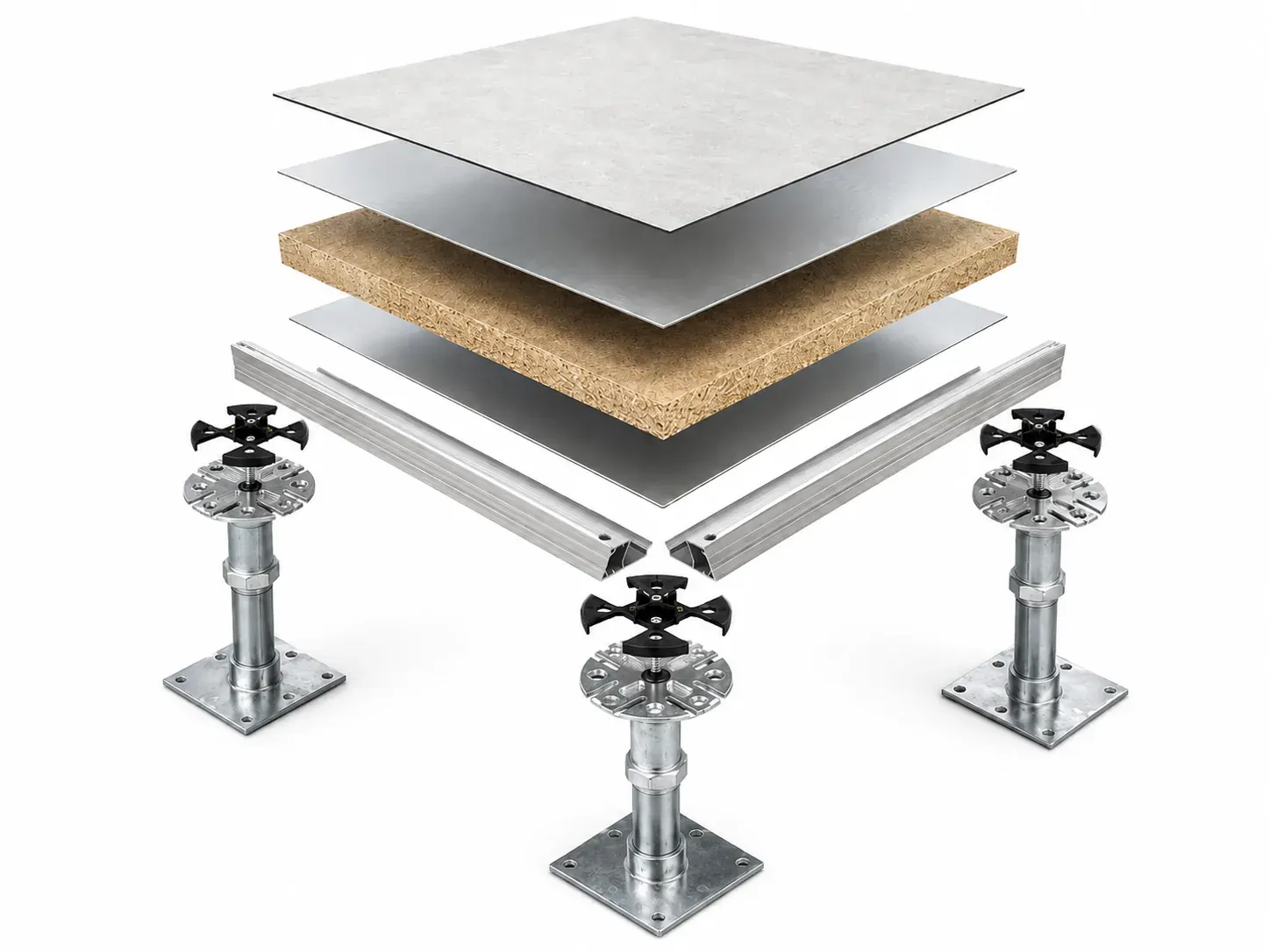
Chipboard, calcium sulphate, steel, aluminium or glass: each panel type has its own load capacity, weight, reaction to fire and acoustic performance. Here are the differences at a glance.
| Panel type | Thickness | System weight | Point load | Reaction to fire without finish * |
|---|---|---|---|---|
| Chipboard | 28 to 38 mm | 24 to 50 kg/m² | up to 10 kN | B |
| Calcium sulphate | 20 to 44 mm | 36 to 90 kg/m² | 2 to 20 kN | A1 or A2 |
| Steel | 28 to 44 mm | 30 to 45 kg/m² | 3 to 7 kN | A1 |
| Cast aluminium | 44 to 62 mm | 27 to 42 kg/m² | 5 to 10 kN | A1 or A2 |
| Glass | approx. 38 mm | approx. 89 kg/m² | approx. 5 kN | A1 |
* Reaction to fire of the bare panel. A1 and A2 are non-combustible, B is of limited combustibility. A finish such as carpet or vinyl can lower the class. Values are taken from published product data of raised access floor manufacturers. The exact value depends on thickness, underlay, finish and substructure. For each project we provide the data sheet of the selected panel.
Panels with a core of high-quality, high-density chipboard, usually with an underside of aluminium foil or steel sheet. Chipboard is light and economical, which makes it the standard in many offices. A chipboard panel is not non-combustible, but it is of limited combustibility (class B), and a chipboard raised floor achieves a fire resistance of up to REI 30. Choose a version with emission class E1 so that hardly any formaldehyde is released.
Calcium sulphate is a mixture of gypsum, water and paper fibres, pressed under high pressure into a very dense panel of approx. 1,500 to 1,600 kg/m³. It is roughly twice as heavy as chipboard, and that shows in its properties: the panel is non-combustible (A2 or A1), has good sound insulation and copes better with a little moisture. With the right thickness and substructure, a calcium sulphate floor achieves a fire resistance of REI 30 to REI 60.
Thanks to its wide range of load capacities, from 2 kN in an office to 20 kN in a plant room, calcium sulphate is the most widely used panel for a computer floor.
Steel panels are powder-coated or galvanised and fully non-combustible (A1). They are light and strong, and widely used in data centres, often as airflow panels: with an open area of 12 to 51 percent, the panel delivers cool air from the plenum to the server racks. Some versions have an adjustable damper to set the airflow per panel.
Cast aluminium panels are light, strong and non-magnetic. They are mainly used in cleanrooms and high-tech manufacturing, often perforated with an open area of over 50 percent for airflow, and with a conductive powder coating to drain static charge.
Panels of laminated safety glass make the space beneath the floor visible, for example in a showroom or museum. They are non-combustible but heavy, and are usually combined with standard panels.
Fire safety of a raised floor involves two things that are often confused:
Fire barriers can also be installed under the floor to stop fire and smoke spreading through the plenum.
A raised floor has a void that can act as a sound channel. That is why three values are measured:
Heavier panels generally insulate better, but the build-up of the whole floor determines the end result: the finish, the edge seals and the barriers under the floor matter just as much. For meeting rooms and offices with strict requirements, there are also special acoustic panels that absorb sound within the room itself.
The panels rest on adjustable galvanised steel pedestals that are bonded to the subfloor. The height can be set from approx. 25 mm to 2,000 mm, and even higher in special cases. From a height of around 500 mm, the pedestals are usually linked with stringers for extra stability. For heavy point loads above 20 kN, such as transformers or UPS systems, we use a system floor with steel C-sections. Also read how high a raised floor can be.
Start with the load and the fire requirements. For an office, a calcium sulphate or chipboard panel rated at 2 to 4 kN is often sufficient. A data centre or plant room usually calls for calcium sulphate or steel in a higher class, and a cleanroom for perforated aluminium. The European standard EN 12825 classifies panels by ultimate load, from class 1 (at least 4 kN) to class 6 (at least 12 kN). With the usual safety factor of 2, the permissible working load is half of that.
We work with panels from various European manufacturers and recommend, for each project, the panel that suits your load, fire requirements, acoustics and budget.
Heavy-duty calcium sulphate and cast aluminium achieve the highest point loads, up to 10 to 20 kN. For even heavier loads we use a system floor with steel stringers.
Yes. Calcium sulphate, steel, aluminium and glass are non-combustible (A1 or A2). Chipboard is of limited combustibility. With the right build-up, the complete floor achieves a fire resistance of REI 30 to REI 60.
It means the complete floor retains its load-bearing capacity, integrity and insulation for at least 30 minutes in a fire. REI 60 or F60 stands for 60 minutes.
Heavy panels such as calcium sulphate insulate best. A carpet finish also greatly reduces impact sound. Acoustic panels are available for extra absorption.